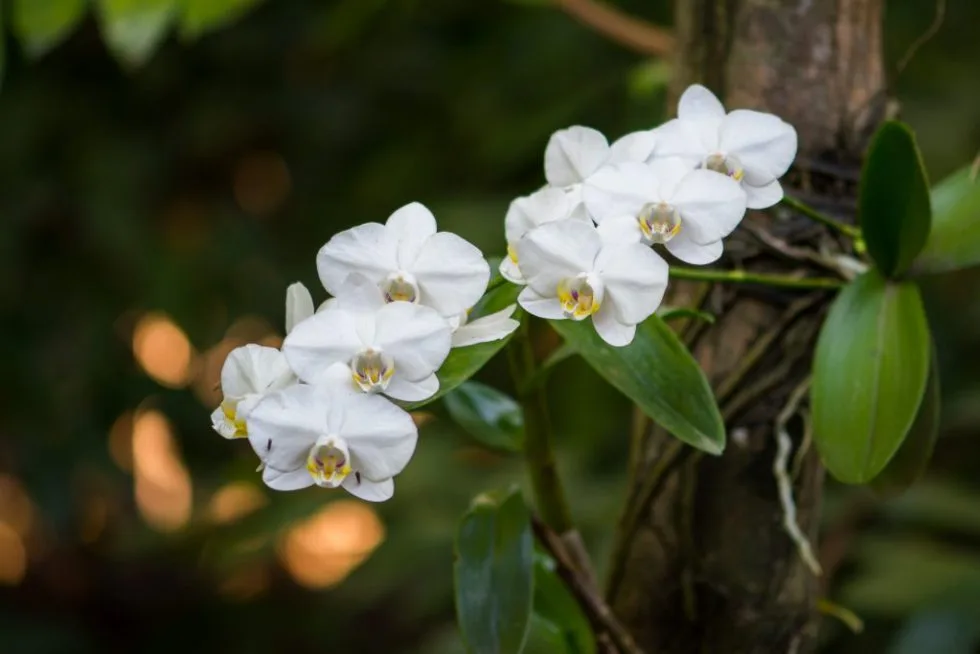
Many rainforest orchids have aerial roots covered in a spongy material called velamen. This adaptation allows them to absorb moisture and nutrients directly from the humid air. Some also have thickened stems called pseudobulbs to store water during brief dry spells.
Orchids represent one of the largest and most diverse families of flowering plants, with thousands of species thriving in tropical rainforest biomes across the Americas, Asia, and Africa. Many orchids grow as epiphytes, anchoring themselves to tree branches and trunks high in the canopy rather than rooting in the soil. This lifestyle exposes them to abundant sunlight but also to challenges like limited water and nutrient availability, fluctuating humidity, and occasional dry spells between rains. Their adaptations allow them to exploit the canopy niche effectively, avoiding competition on the dark forest floor while accessing better light for photosynthesis.
A standout adaptation in epiphytic orchids is the velamen radicum, a thick, spongy layer of dead cells covering their aerial roots (except at the growing tip). This velamen acts like a highly efficient sponge, rapidly absorbing rainwater, mist, and dissolved minerals directly from the humid air and brief downpours common in the rainforest. The structure quickly soaks up moisture—often reaching near saturation in seconds—then allows excess water to evaporate, preventing rot in the warm, oxygenated environment. By enabling direct foliar-like absorption through the roots, the velamen reduces dependence on scarce soil resources and helps the plant capture fleeting water supplies in the exposed canopy.
Many orchids further enhance survival with pseudobulbs, swollen storage organs formed from thickened stems that act as water and nutrient reservoirs. These fleshy structures store surplus water absorbed during heavy rains, along with carbohydrates and minerals, allowing the plant to draw on internal reserves during drier intervals or seasonal fluctuations in the rainforest. Pseudobulbs are especially vital for species with deciduous leaves or those experiencing short dry spells, providing a buffer that sustains growth and flowering when external water is temporarily limited. This storage adaptation supports the orchid’s ability to endure the variable moisture levels of the upper forest layers.
Another critical adaptation is Crassulacean Acid Metabolism (CAM) photosynthesis, employed by many epiphytic orchids. Unlike most plants that open stomata during the day, CAM species keep stomata closed in daylight to minimize water loss through transpiration in the hot, breezy canopy. They open stomata at night when humidity is higher and temperatures are cooler, absorbing carbon dioxide and storing it as organic acids. During the day, the acids are broken down to release CO2 for photosynthesis while stomata remain shut. This greatly improves water-use efficiency, enabling orchids to conserve moisture in an environment where evaporation rates can be high despite overall rainforest humidity.
Epiphytic orchids also feature thick, leathery, or waxy leaves that reduce water loss through transpiration and protect against intense sunlight and wind. Their adventitious roots serve primarily for anchorage, clinging tightly to bark with a strong grip that withstands tropical storms and heavy rains, while the velamen handles absorption. Some species form symbiotic relationships with mycorrhizal fungi, which further aid in nutrient uptake from organic debris trapped on branches. Collectively, these adaptations allow orchids to thrive as non-parasitic canopy dwellers, supporting miniature ecosystems and contributing to the incredible biodiversity of tropical rainforests.