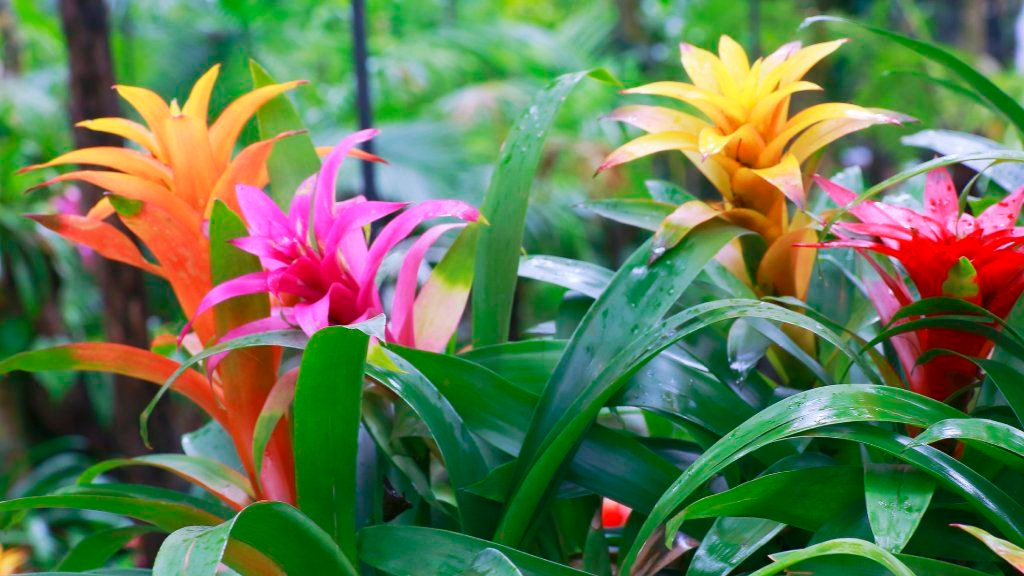
Their leaves grow in a tight rosette shape that forms a central “tank” or bowl. This adaptation allows them to catch and store gallons of rainwater. This reservoir provides the plant with a steady supply of moisture and nutrients from decaying organic matter that falls into the water.
Bromeliads are a fascinating family of flowering plants native to the Americas, thriving predominantly in the tropical rainforest biome where competition for resources is intense. These plants often grow as epiphytes high in the forest canopy, far from the soil, facing challenges like inconsistent water availability and limited nutrient access. One remarkable adaptation is the rosette arrangement of their overlapping leaves, which forms a central tank known as a phytotelma. This tank collects and stores rainwater along with falling organic debris such as leaves and insects, creating a self-contained reservoir that can hold several liters of water.
The tank adaptation is crucial for survival in the rainforest’s upper canopy, where rainfall can be abundant but interspersed with dry periods due to high evaporation rates and wind exposure. By trapping water directly in their leaf bases, bromeliads avoid dependence on scarce soil moisture or deep root systems. The stored water sustains the plant during droughts, while the accumulated debris breaks down into nutrients that the plant absorbs, supporting growth in an environment where traditional soil-based nutrition is unavailable. This allows bromeliads to colonize tree trunks and branches, positioning themselves closer to sunlight without competing on the shaded forest floor.
Another key adaptation is the presence of specialized leaf scales called trichomes, which cover the surface of many bromeliad leaves like a silvery or fuzzy coating. These trichomes are not mere hairs but complex structures with absorbent cells that draw in moisture and dissolved minerals directly from the air, mist, or water held in the tank. In the humid yet variable conditions of the tropical rainforest, trichomes maximize water uptake even during brief dry spells or in species that live as “atmospheric” bromeliads with minimal tank formation.
Trichomes enhance survival by enabling foliar absorption, a process that bypasses the need for extensive roots to gather resources from the environment. This reduces water loss through the soil and protects the plant from desiccation in the exposed canopy, where direct sunlight can quickly dry out surfaces. Additionally, some trichomes reflect excess light to prevent overheating, conserving energy for photosynthesis and helping bromeliads endure the intense solar radiation and fluctuating humidity typical of their biome.
Many bromeliads also employ Crassulacean Acid Metabolism (CAM) photosynthesis, a biochemical pathway that allows them to open their stomata primarily at night to take in carbon dioxide while minimizing daytime water loss. In the hot, windy canopy of the tropical rainforest, where transpiration rates soar during daylight hours, this adaptation dramatically reduces water evaporation compared to standard daytime photosynthesis used by most plants. By storing carbon dioxide as acids overnight and converting it to sugars during the day with closed stomata, bromeliads maintain efficient energy production even in drier microclimates or seasonal dry spells within the rainforest.
Finally, the adventitious roots of epiphytic bromeliads serve primarily as anchoring structures rather than primary absorbers, clinging tightly to tree bark with a Velcro-like grip. This adaptation secures the plant against strong winds and heavy rains common in tropical storms, preventing it from being dislodged from its elevated perch. By using roots solely for attachment, bromeliads free up energy for leaf-based resource collection, thriving as non-parasitic guests that access better light and avoid ground-level herbivores and flooding. Together, these adaptations enable bromeliads to dominate their niche and support entire miniature ecosystems within their tanks.